

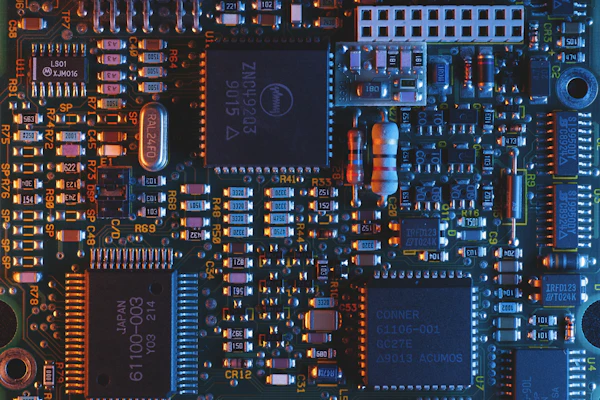
Discover everything about Embedded engineer
Discover how well your profile matches a role as Embedded engineer. Get insight into which skills you already have, which you can still develop and which courses or learning paths fit your next step.

Embedded engineer in short
Embedded engineer is a function within Computers, electronics and optics, part of the branch Computers, electronics and optics. Every figure on this page comes from our own market data for this function.
- Domain
- Computers, electronics and optics
- Branch
- Computers, electronics and optics
- Open job opportunities
- 0
- Measured skills
- 6 · Measured for this function
- Salary source
- National benchmark, 1.300 observations
Salary & employment conditions
gross per month · National benchmark, 1.300 observations
Employment conditions
Benchmarked in the job opportunities for this function.
- Vakantiedagen
- 83% of job opportunities
- Opleidingsbudget
- € 2.000 per year
- Pensioenregeling
- 67% of job opportunities
- Reiskosten
- 50% of job opportunities
- Bonusregeling
- 33% of job opportunities
- Thuiswerken
- 33% of job opportunities
Day-to-day work
Taken from the descriptions employers published on their own job opportunities.
Employers have not described the tasks for this function yet.
Skills
Benchmark score per skill for this function, on a scale of 0 to 100.
Next functions
The share of professionals that made this step, and how long it took them.
Frequently asked questions about Embedded engineer
What does a Embedded engineer earn?
A Embedded engineer earns between € 2.760 and € 5.626 gross per month in our market data, with € 3.941 as the typical medior salary. Where you land inside that range depends on your years of experience, your region and the size of your employer.
Can you become a Embedded engineer without experience?
Starting without experience is possible, but it depends on the level. Our data puts the entry salary around € 2.760 gross per month, and a junior is expected to bring C/C++, Embedded Linux, Python at a basic level plus the drive to grow quickly.
Which skills do you need as a Embedded engineer?
Employers hiring a Embedded engineer ask most often for C/C++, Embedded Linux, Python. Our benchmark scores those skills highest for this role, so start there. Soft skills such as communication and collaboration decide the rest: they separate two candidates with the same technical profile.
Which education fits a Embedded engineer?
Employers mention HBO/WO Informatica, Embedded Systems of Computer Science, HBO/WO Elektrotechniek of Technische Informatica most often in their Embedded engineer job opportunities, and 13% of those openings names the first one. A diploma is rarely the only route though: demonstrable projects, a targeted certificate and experience from a neighbouring role count just as heavily.
What is the next step after Embedded engineer?
We do not measure progression steps for this role yet. Related functions inside Computers, electronics and optics are the obvious next move: they ask for a comparable set of skills, so switching costs you little retraining. Create a profile and we map your own route.
Is there much demand for a Embedded engineer?
There is no open job opportunity for this role at the moment. That says little about the labour market as a whole: vacancies for this function appear irregularly and are often filled quickly. Create a profile and we notify you as soon as one is published.
Curious how you score on Embedded engineer?
Create an anonymous profile and see straight away which skills you already have, what you can earn and which next step fits you.